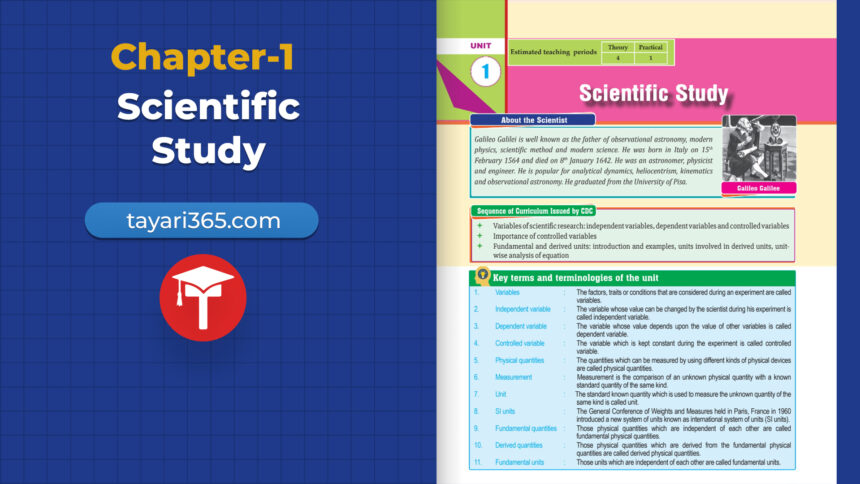
Class 10 Science Chapter 1 Scientific Learning is one of the most essential foundation chapters in your science syllabus. In this chapter, you will explore how science works as a systematic process — covering the scientific method, types of variables, units of measurement, and dimensional analysis. Whether you are preparing for board exams or building your science foundation, this complete guide to Class 10 Science Chapter 1 Scientific Learning will help you understand every concept with logical clarity and confidence.
Introduction to Scientific Learning
Scientific Learning involves a systematic investigation to understand natural phenomena. It uses observation, experimentation, and analysis to discover laws and principles of science.
- Science is evidence-based.
- It requires logical reasoning, precise measurement, and verification.
- The scientific method includes:
- Observation
- Question
- Hypothesis
- Experiment
- Analysis
- Conclusion
Variables in Scientific Research
What is a Variable?
A variable is any quantity or factor that can change or be manipulated in an experiment.
Types of Variables
| Variable Type | Definition | Example |
| Independent Variable | The variable you change to observe effects | Amount of sunlight in plant growth experiment |
| Dependent Variable | The variable you measure or observe | Plant height in response to sunlight |
| Controlled Variable | The variable kept constant | Type of plant, soil used |
| Extraneous Variable | Variables that could affect the outcome, but are not intended | Temperature, humidity |
Memory Tip:
I = I change (Independent),
D = Data you collect (Dependent),
C = Constant (Controlled)
4. Units and Their Types
What is a Unit?
A unit is a standard quantity used to measure physical quantities.
Types of Units:
- Fundamental (Base) Units
- Cannot be derived from other units
- Examples (SI Units):
- Length → metre (m)
- Mass → kilogram (kg)
- Time → second (s)
- Temperature → kelvin (K)
- Electric current → ampere (A)
- Amount of substance → mole (mol)
- Luminous intensity → candela (cd)
- Derived Units
- Formed by combining fundamental units
- Examples:
- Speed = m/s
- Force = newton (N) = kg·m/s²
- Work = joule (J) = N·m
Memory Tip:
Remember “King Henry Died By Drinking Chocolate Milk” for metric units:
Kilo, Hecto, Deca, Base, Deci, Centi, Milli
5. Unitwise Analysis of Equations
What is Unitwise Analysis?
Unitwise analysis is the process of checking the units on both sides of an equation to ensure that they are dimensionally consistent.
If LHS unit = RHS unit → Equation is dimensionally correct
If not → The equation is incorrect or incomplete
Importance of Unitwise Analysis – Class 10 Science Chapter 1 Scientific Learning
1. Helps verify correctness of equations
2. Helps derive new formulas
3. Helps convert one unit system to another
4. Ensures logical accuracy in physical laws
Flowchart of Scientific Method
Observation → 2. Hypothesis → 3. Experiment → 4. Result → 5. Conclusion
Interesting Facts about the Chapter
- The word “science” comes from the Latin word “scientia” meaning “knowledge”.
- SI Units were first defined in 1960 by the General Conference on Weights and Measures (CGPM).
- Dimensional analysis is often used by physicists to “test” or “derive” physical laws.
Quick Revision Summary
- Scientific study uses systematic steps to understand phenomena.
- Variables: Independent, Dependent, Controlled, Extraneous.
- Units: Fundamental (base) and Derived units.
- SI system is globally accepted.
- Unitwise analysis helps verify equations and derive new formulas.
Common Mistakes Students Make
- Confusing independent and dependent variables
- Writing incorrect units for physical quantities
- Ignoring unit conversion in equations
- Assuming dimensional correctness guarantees numerical correctness (it doesn’t!)
This completes the full revision of Class 10 Science Chapter 1 Scientific Learning.