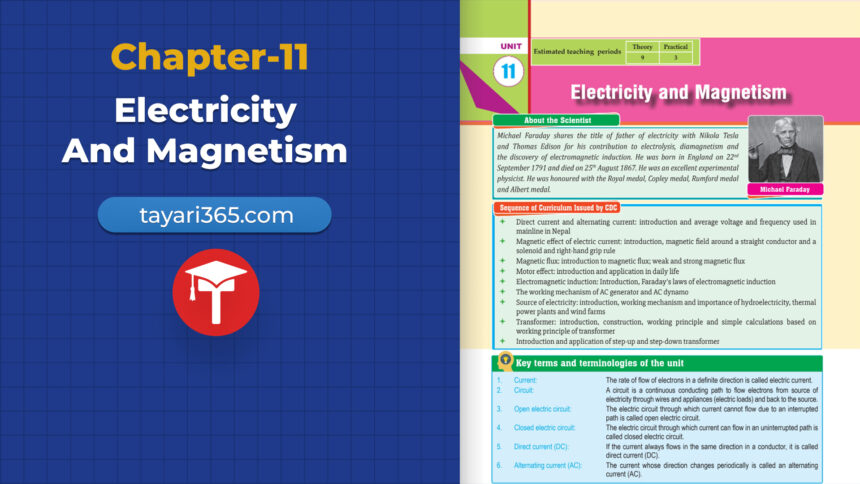
Class 10 Science Chapter 11 Electricity and Magnetism is one of the most technology-rich and formula-based chapters in your science syllabus. In this chapter, you will explore direct and alternating current, the magnetic effect of electric current, electromagnetic induction, motors, generators, transformers, and various sources of electrical power. From understanding how a transformer steps up voltage for long-distance transmission to learning how Nepal’s hydropower stations generate clean energy, this complete guide to Class 10 Science Chapter 11 Electricity and Magnetism will help you master every concept, formula, and application with clarity and confidence.
1. Introduction to Electricity and Magnetism
Electricity and magnetism are closely linked phenomena:
- Electricity involves the flow of electric charges (electrons).
- Magnetism arises from moving charges and affects magnetic materials.
These two fields unify under electromagnetism, governing many modern technologies.
2. Direct Current (DC) vs Alternating Current (AC)
Direct Current (DC)
- Definition: Electric charge flows in one constant direction.
- Sources: Batteries, solar cells, DC generators.
Alternating Current (AC)
- Definition: Electric charge periodically reverses direction.
- Characteristics: Defined by frequency (Hz) and waveform (usually sine wave).
Comparison Table :-
| Feature | DC | AC |
| Direction | Unidirectional | Reversing periodically |
| Source | Batteries, solar cells | Power plants, home outlets |
| Voltage & Current | Constant | Varies over time |
| Energy Transmission | Suitable for short distances | Ideal for long-haul transmission (reduces loss) |
| Frequency | 0 Hz | 50 Hz (Nepal/India), 60 Hz (US) |
| Waveform | Straight line | Sine wave |
| Applications | Electronics, small appliances | Homes, industries, lighting |
3. Converting AC to DC
- Bridge rectifier – Uses diodes to convert AC to pulsating DC.
- Filtering – Capacitors smooth the DC output.
- Voltage regulators ensure constant DC level (e.g., for chargers).
4. Magnetic Effect of Electrical Current
4.1 Magnetic Field Around a Straight Wire
- Current generates a magnetic field in concentric circles.
- Maxwell’s Right-hand Thumb Rule: Thumb along current, fingers show magnetic field direction.
4.2 Magnetic Field Around a Solenoid
A solenoid (coil of wire) acts like a bar magnet when carrying current.
Factors affecting field strength:
- Number of turns (N): Field ∝ N
- Electric current (I): Field ∝ I
- Core permeability: Higher permeability → stronger field
- Length and cross-sectional area
- Coil shape and current direction (rule of cork-screw)
At ends of solenoid, field lines expand outward.
5. Magnetic Flux
Magnetic Flux (Φ)
Definition:
Magnetic flux (Φ) measures the total magnetic field passing through a given area.
Formula:
Φ = B × A × cos(θ)
Where:
θ = Angle between magnetic field and the normal (perpendicular) to the surface
Φ = Magnetic flux (in Weber, Wb)
B = Magnetic field strength (in Tesla, T)
A = Area through which the field lines pass (in m²)
6. Motor Effect
- A current-carrying conductor in a magnetic field experiences a force.
- Key Features:
- Force direction given by Fleming’s Left-hand Rule:
Thumb: Force, Forefinger: Field, Middle: Current - Magnetic Force on a Current-Carrying Conductor
- Formula:
- F = B × I × L × sin(θ)
- Where:
- F = Magnetic force (in newtons, N)
- B = Magnetic field strength (in tesla, T)
- I = Current (in amperes, A)
- L = Length of the conductor (in meters, m)
- θ = Angle between the conductor and the magnetic field
- Force direction given by Fleming’s Left-hand Rule:
Applications:
- DC motors (fans, toys, small appliances)
- Working principle: Force on coil causes rotation; commutator reverses current to maintain torque.
- Other applications: Speakers, electric drills
7. Electromagnetic Induction
Current induced in a conductor due to changing magnetic environment.
Key Points:
- Requires magnetic field, changing flux, and conductor moving or stationary.
- Faraday’s Laws:
- Induced emf ∝ rate of change of magnetic flux.
- Direction predicted by Lenz’s Law: Induced current opposes the flux change.
Devices:
- Dynamo: Generates DC via rotating coil + commutator.
- AC Generator (Alternator): Generates AC using rotating coil + slip rings.
8. Sources of Electrical Power
- Hydropower station: Uses water flow to rotate turbines.
- Thermal power plant: Burns fuel to produce steam driving turbines.
- Wind turbine: Converts wind energy via rotor blades.
- Nuclear power plant: Nuclear fission heats water to produce steam.
Transformers – Class 10 Science Chapter 11 Electricity and Magnetism
9.1 Types:
- Step-up: Increases voltage (lower current, longer transmission)
- Step-down: Decreases voltage (safer for household use)
9.2 Working Principle:
- Applies AC to primary coil → changing magnetic flux in core → induces emf in secondary coil.
9.3 Structure:
- Iron core (high permeability)
- Primary and secondary windings
- Insulation (oil, varnish) prevents electrical breakdown
9.4 Transformation Formula:
Formula:
Vs Vp = Ns Np
Where:
Vs/Vp = Voltage ratio
Ns/Np = Turns ratio
🧮 Working Example:
Transformer Voltage Calculation
Given:
- Vp = 230 V
- Np = 100
- Ns = 1000
Formula:
Vs = Vp × (Ns / Np)
Calculation:
Vs = 230 × (1000 / 100) = 2300 V
Therefore, the secondary voltage Vs is 2300 volts.
10. Electric Generators
AC generators (alternators) use rotating coils in magnetic fields to produce electricity (rarely DC).
Interesting Facts
- Tesla’s inventing of AC power resolved inefficiencies of earlier DC systems!
- Hydropower stations in Nepal (e.g., Kali Gandaki) provide clean energy.
- Transformers work only with AC, not DC.
- Wind turbines generate electricity at variable power depending on wind speed.
Quick Revision Summary
- DC vs AC: Uni vs bidirectional current; applications vary.
- Magnetism from currents: Straight wires, solenoids → field produced.
- Motor effect: Force on conductor in magnetic fields → rotation in motors.
- Electromagnetic induction: Current produced by changing flux (Faraday’s laws).
- Transformers: Change voltage via winding ratios.
- Power generation: Hydropower, thermal, wind, and nuclear sources.
Common Misconceptions
- Confusing DC with AC (frequency absent in DC)
- Assuming generator produces DC without highlighting dynamo vs alternator
- Misapplying Fleming’s rules
- Transformer works only with alternating current
- Neglecting transformer insulat ion and its importance
This completes the full revision of Class 10 Science Chapter 11 Electricity and Magnetism.