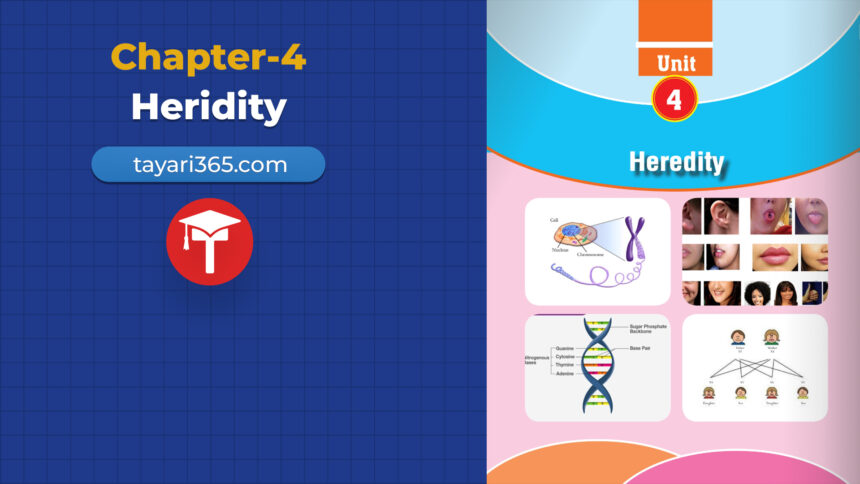
Class 10 Science Chapter 4 Heredity is one of the most important and scoring chapters in your science syllabus. In this chapter, you will explore how traits are passed from parents to offspring through genes, the difference between mitosis and meiosis, the structure of DNA and RNA, Mendel’s laws of inheritance, and modern genetic technologies like IVF and artificial insemination. From understanding monohybrid crosses to learning how DNA testing works, this complete guide to Class 10 Science Chapter 4 Heredity will help you master every concept with clarity and confidence.
Heredity
= Heredity is the transmission of traits (characters) from parents to offspring.
Genes
= A gene is the basic unit of heredity made up of DNA, which determines specific characteristics.
- Located on chromosomes
- Control traits like height, eye color, etc.
Genetics
= Genetics is the branch of science that studies heredity and variation.
2. Cell Division
= Cell division is the process by which a parent cell divides into two or more daughter cells.
Somatic Cells vs. Gametogenic Cells
| Feature | Somatic Cells | Gametogenic Cells |
| Also called | Body cells | Sex cells (sperm/egg) |
| Chromosomes | Diploid (2n) | Haploid (n) |
| Cell division | Mitosis | Meiosis |
| Role | Growth and repair | Reproduction |
3. Types of Cell Division
Mitosis (Equational Cell Division)
- Occurs in somatic cells
- Produces two identical daughter cells
- Each daughter cell has the same number of chromosomes as the parent cell (2n → 2n)
Main Features of Mitosis
- One division only
- No change in chromosome number
- Four phases: Prophase, Metaphase, Anaphase, Telophase
Significance of Mitosis
- Growth of organisms
- Repair and regeneration of tissues
- Asexual reproduction
Meiosis (Reduction Division)
- Occurs in gametogenic cells
- Produces four haploid daughter cells (2n → n)
- Involves two successive divisions
Two Main Stages of Meiosis:
- Meiosis I – Homologous chromosomes separate
- Meiosis II – Sister chromatids separate
Main Features
- Chromosome number is halved
- Introduces genetic variation
- Four non-identical cells produced
Significance of Meiosis
- Maintains chromosome number in species
- Creates genetic diversity through recombination
4. DNA (Deoxyribonucleic Acid)
Structure of DNA
- Double helix (like a twisted ladder)
- Made of nucleotides: phosphate, sugar (deoxyribose), nitrogen base
- Bases: Adenine (A), Thymine (T), Cytosine (C), Guanine (G)
🔁 A pairs with T, C pairs with G
Functions of DNA
- Stores genetic information
- Directs protein synthesis
- Passes traits to the next generation
5. RNA (Ribonucleic Acid)
Structure of RNA
- Single-stranded
- Sugar: Ribose
- Bases: A, Uracil (U), C, G
(No thymine)
Functions of RNA
- Helps in protein synthesis (mRNA, tRNA, rRNA)
- Carries messages from DNA to ribosomes
6. Chromosomes
Structure of Chromosomes
- Thread-like structures made of DNA and proteins
- Visible during cell division
Types of Chromosomes
- Autosomes – Body chromosomes (in humans: 22 pairs)
- Sex chromosomes – Determine sex (1 pair)
Number of Chromosomes
- Humans: 46 chromosomes (23 pairs)
- 44 autosomes
- 2 sex chromosomes (XX in females, XY in males)
7. Sex Determination
- Determined by sex chromosomes
- Male: XY, Female: XX
- Male sperm determines the sex of the baby
Mnemonic: “XY means a guy”
8. Mendelism and Genetic Technology
Gregor Mendel’s Work
- Father of Genetics
- Conducted experiments on pea plants
Mendel’s Material:
- Garden pea (Pisum sativum)
Why Pea Plants?
- Short life cycle
- Easily distinguishable traits
- Can self- or cross-pollinate
- Easy to grow and maintain
Dominant and Recessive Traits
| Type | Expressed When | Example |
| Dominant | At least one dominant allele present | Tall (T) |
| Recessive | Only when both alleles are recessive | Dwarf (tt) |
Genotype vs. Phenotype
| Term | Meaning | Example |
| Genotype | Genetic makeup | TT, Tt, tt |
| Phenotype | Physical appearance | Tall or Dwarf |
Monohybrid Cross
- Cross between parents with one pair of contrasting traits
e.g., Tall (TT) × Dwarf (tt)
Dihybrid Cross
- Cross involving two pairs of contrasting traits
e.g., Round Yellow × Wrinkled Green seeds
Mendel’s Laws
- Law of Dominance
Dominant allele masks the effect of a recessive allele. - Law of Segregation
Alleles segregate during gamete formation and reunite during fertilization.
Introduction to Genetic Technology – Class 10 Science Chapter 4 Heredity
Definition
= Genetic technology involves manipulating genes to improve or modify organisms.
Methods:
- DNA testing
- Genetic engineering
- Gene therapy
- Recombinant DNA techniques
Advantages of Genetic Technology
- Cure genetic diseases
- Improve crop and animal breeds
- Solve paternity and crime investigations
- Produce insulin, vaccines, etc.
10. Role of DNA Testing
- Paternity testing
- Crime investigations
- Identification of genetic diseases
- Research in ancestry and evolution
11. Selective Breeding
Definition:
= Breeding organisms with desirable traits to produce better offspring.
Advantages:
- Improves yield
- Enhances resistance to diseases
- Better quality meat, milk, crops
Disadvantages:
- Reduces genetic variation
- Risk of inherited diseases
12. Methods of Selective Breeding
Inbreeding
- Mating between closely related individuals
✅ Fixes traits
❌ Can increase genetic disorders
Line Breeding
- Inbreeding with less close relatives
- Maintains useful traits with less risk
Self-Pollination
- Fertilization within the same flower
✅ Maintains purity
❌ No variation
Cross-Pollination
- Fertilization between different flowers
✅ More variation
❌ Risk of unwanted traits
13. Cross Breeding
Advantages
- Increases genetic variation
- Improves productivity and resistance
Disadvantages
- Unpredictable traits
- May lose some desired traits
Examples of Cross-Bred Organisms
- Mule (Donkey × Horse)
- Triticale (Wheat × Rye)
14. Artificial Insemination (AI)
Definition
Introducing sperm into the female’s uterus without natural mating.
Advantages:
- Controlled breeding
- Disease-free sperm
- High-quality offspring
Disadvantages:
- Costly and technical
- Not always successful
15. In-Vitro Fertilization (IVF)
- Fertilization outside the body, in a lab
- Egg and sperm are combined in a test tube
About Louise Brown
- First baby born through IVF in 1978, UK
Procedure:
- Eggs and sperms collected
- Fertilization done in a lab
- Embryo inserted into uterus
Advantages
- Helps infertile couples
- Increases chances of pregnancy
Disadvantages
- Expensive
- Ethical issues
- May lead to multiple births
Interesting Facts about Heredity
- Humans share about 98.8% DNA with chimpanzees!
- One strand of DNA is 2 meters long when uncoiled.
- Gregor Mendel used over 28,000 pea plants in his experiments.
- There are about 20,000–25,000 genes in the human genome.
Quick Revision Summary
- Heredity passes traits; genes carry information
- Mitosis (growth), Meiosis (reproduction)
- DNA stores info, RNA helps make proteins
- Chromosomes: 46 in humans, determine traits & sex
- Mendel discovered inheritance laws via pea plants
- Genetic tech helps improve organisms
- Selective breeding, AI, IVF help enhance reproduction
Common Mistakes Students Make
1. Confusing mitosis and meiosis
2. Assuming both parents decide baby’s sex (only sperm decides!)
3. Mixing genotype with phenotype
4. Forgetting function of royal jelly
5. Assuming artificial insemination and IVF are the same
This completes the full revision of Class 10 Science Chapter 4 Heredity.