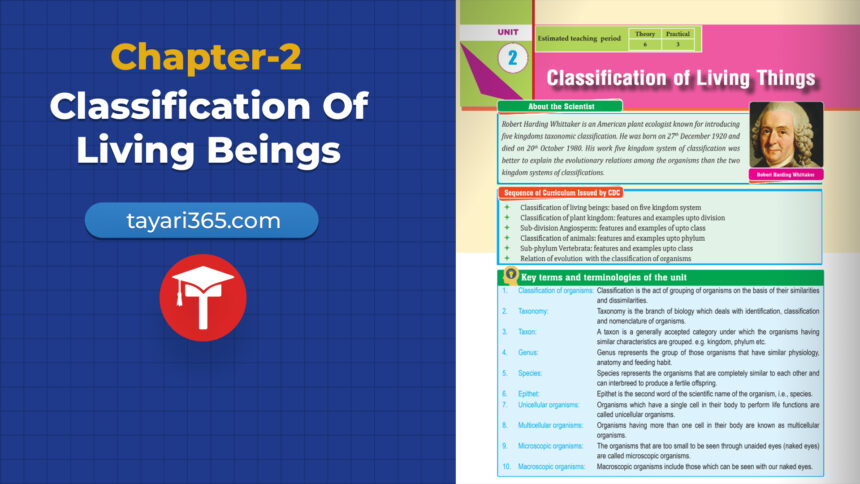
Class 10 Science Chapter 2 Classification of Living Beings is one of the most comprehensive and interesting chapters in your science syllabus. In this chapter, you will explore the five kingdom system of classification, the plant kingdom divisions from algae to angiosperms, the animal kingdom with its nine phyla, and how classification is directly linked to evolution. Whether you are memorizing phylum features or comparing monocots and dicots, this complete guide to Class 10 Science Chapter 2 Classification of Living Beings will help you master every concept clearly and confidently.
1. Introduction to Classification
Classification is the systematic grouping of living organisms based on their similarities and differences. It is essential for:
• Understanding the diversity of life
• Identifying and naming organisms (taxonomy)
• Studying evolutionary relationships
- Classification was first attempted by Aristotle, and later developed more scientific ally by Carolus Linnaeus.
- The modern system of classification uses binomial nomenclature, where each organism is named using Genus + species.
Interesting Fact: The binomial system is universally accepted and written in Latin, ensuring a common scientific language across regions.
2. Five Kingdom System of Classification
Proposed by R.H. Whittaker in 1969, this system classifies all organisms into five distinct kingdoms based on cellular organization, nutrition, and reproduction.
| Kingdom | Cell Type | Cell Number | Nutrition | Examples |
| Monera | Prokaryotic | Unicellular | Autotroph or Heterotroph | Bacteria, Cyanobacteria |
| Protista | Eukaryotic | Mostly unicellular | Both types | Amoeba, Paramecium |
| Fungi | Eukaryotic | Multicellular | Heterotroph (saprophytic) | Yeast, Mushroom |
| Plantae | Eukaryotic | Multicellular | Autotroph | Ferns, Algae, Flowering plants |
| Animalia | Eukaryotic | Multicellular | Heterotroph | Humans, Fish, Insects |
Mnemonic for recall: My Papa Found Pizza Amazing!
3. Kingdom Plantae
Composed of multicellular, eukaryotic, autotrophic organisms containing chlorophyll. This kingdom is classified into several divisions:
Division: Algae
• Aquatic, simple non-vascular plants
• Do not possess true roots, stems, or leaves
• Can be unicellular (e.g., Chlamydomonas) or multicellular (e.g., Spirogyra)
Key Features of Algae
• Contain chlorophyll → capable of photosynthesis
• Reproduce through vegetative and sexual methods
• Typically inhabit freshwater and marine environments
Importance of Algae
• Major producers of oxygen in aquatic ecosystems
• Form the base of many aquatic food chains
• Utilized in the production of agar, iodine, and biofuels
Interesting Fact: Algae are responsible for producing over 70% of Earth’s oxygen, more than all forests combined.
Division: Bryophyta
• Non-vascular plants (lack xylem and phloem)
• Typically grow in moist environments like damp soil, rocks, and shaded walls
Key Features of Bryophyta
• Lack true roots, stems, and leaves
• Possess rhizoids for attachment and limited absorption
• Reproduce through spores
Why Are Bryophyta Called Amphibian Plants?
= Because they require water for fertilization but live on land.
Interesting Fact: Bryophytes are often the first plants to colonize barren rocks in ecological succession.
What is Alternation of Generation?
A life cycle involving two distinct stages:
• Gametophyte (haploid) – produces gametes (sex cells)
• Sporophyte (diploid) – produces spores
These two stages alternate in many plant groups, especially bryophytes and ferns, ensuring both sexual and asexual reproduction.
Division: Tracheophyta (Vascular Plants)
• Contain xylem and phloem for water and nutrient transport
• Have well-developed roots, stems, and leaves
Sub-division: Pteridophyta
• Non-flowering and seedless
• Reproduce by spores
• Examples: Ferns, Marsilea
Sub-division: Gymnospermae
• Produce naked seeds (not enclosed in fruit)
• Mostly evergreen and woody
• Examples: Pine, Cycas
Sub-division: Angiospermae
• Produce flowers and fruits containing seeds
• Most diverse group of plants
Comparison: Monocot vs Dicot
| Feature | Monocot | Dicot |
| Cotyledons | One | Two |
| Leaf venation | Parallel | Reticulate (net-like) |
| Root type | Fibrous | Tap root |
| Examples | Wheat, Maize, Rice | Mustard, Pea, Sunflower |
4. Kingdom Animalia
• Multicellular, eukaryotic, heterotrophic organisms
• Do not have a cell wall
• Most exhibit movement and are highly specialized
Key Features
• Primarily reproduce sexually
• Have well-organized tissues and organ systems
• Show high mobility and sensory coordination
Division into 9 Animal Phyla
| Phylum | Key Features | Example |
| Porifera | Pores all over body, no true organs | Sponge |
| Cnidaria | Stinging cells, radial symmetry | Hydra, Jellyfish |
| Platyhelminthes | Flatworms, bilateral symmetry | Tapeworm |
| Nematoda | Roundworms, cylindrical body | Ascaris |
| Annelida | Segmented body | Earthworm |
| Arthropoda | Jointed legs, exoskeleton | Insects, Spider |
| Mollusca | Soft body, often with shell | Snail, Octopus |
| Echinodermata | Spiny skin, radial symmetry (adults) | Starfish, Sea Urchin |
| Chordata | Notochord present during embryonic stage | Humans, Fish |
Interesting Fact: Arthropoda is the largest phylum, accounting for over 80% of all known species.
Subphylum Vertebrata – Five Main Classes
| Class | Key Features | Example |
| Pisces | Aquatic, gills, fins, cold-blooded | Fish |
| Amphibia | Moist skin, live both in water and on land | Frog |
| Reptilia | Dry scaly skin, lay eggs on land, cold-blooded | Snake, Lizard |
| Aves | Feathers, beak, lay eggs, warm-blooded | Crow, Pigeon |
| Mammalia | Hair or fur, give birth, have mammary glands, warm-blooded | Cow, Human |
Relation Between Classification and Evolution – Class 10 Science Chapter 2 Classification of Living Beings
• Classification helps understand evolutionary relationships among organisms
• Organisms with similar features likely share a common ancestor
• Enables scientists to trace lineage and species divergence
Example: Both monkeys and humans belong to the class Mammalia, indicating a close evolutionary link.
Interesting Facts about the Chapter
• An estimated 8.7 million species exist on Earth
• Arthropoda is the largest animal phylum
• Whales and dolphins, though aquatic, are mammals—not fish
• Algae produce nearly 70% of the oxygen in Earth’s atmosphere
Quick Revision Summary
• Classification organizes the diversity of life
• Five Kingdoms: Monera, Protista, Fungi, Plantae, Animalia
• Plantae Divisions: Algae, Bryophyta, Pteridophyta, Gymnospermae, Angiospermae
• Angiosperms: Classified into Monocots and Dicots
• Animalia: 9 Phyla + Vertebrates with 5 classes
• Classification is tied closely to evolutionary theory
Common Mistakes to Avoid
• Mixing up monocot and dicot characteristics
• Forgetting key examples of each phylum or class
• Assuming all aquatic animals are fish (e.g., dolphins are mammals)
• Overlooking alternation of generation in plant life cycles
This completes the full revision of Class 10 Science Chapter 2 Classification of Living Beings.