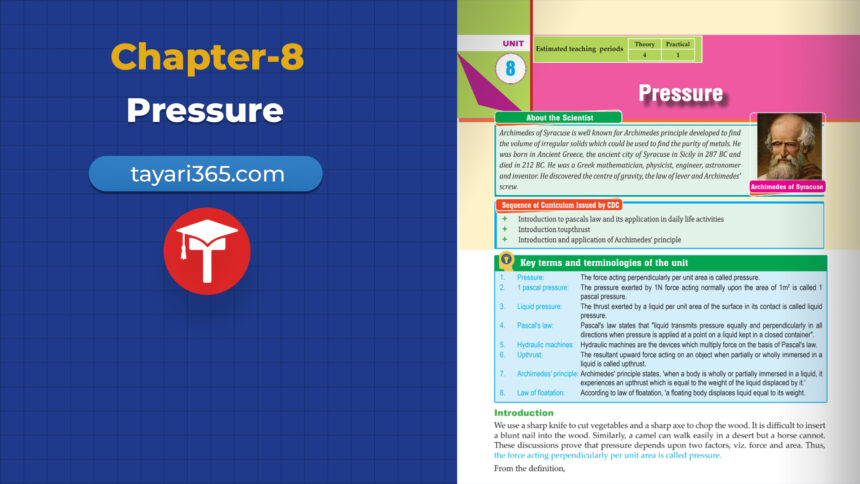
Class 10 Science Chapter 8 Pressure is one of the most practical and formula-rich chapters in your science syllabus. In this chapter, you will explore the concept of pressure, atmospheric pressure, Pascal’s Law, hydraulic machines, upthrust, Archimedes’ Principle, and the law of floatation. From understanding why a sharp knife cuts better to learning how a hydraulic lift works, this complete guide to Class 10 Science Chapter 8 Pressure will help you master every concept, formula, and worked example with clarity and confidence.
1. Introduction to Pressure
Pressure is defined as the force applied per unit area.
Formula:
Pressure (P) = Force (F) / Area (A)
P = F / A
SI Unit: Pascal (Pa)
1 Pascal = 1 N/m²
Examples in Daily Life
- Sharp knife cuts better (less area → more pressure).
- Camels have broad feet to walk on sand (larger area → less pressure).
- School bags with wide straps reduce pressure on shoulders.
2. Atmospheric Pressure
- Air exerts pressure on everything.
- At sea level:
Atmospheric Pressure = 1.01 × 10⁵ Pa
Applications
- Hydraulic press
- Deep sea diving suits
- Tire pressure monitoring
- Human body balance (internal body pressure matches atmospheric pressure)
3. Fluid and Fluid Pressure
- Fluids = liquids and gases.
- Fluids exert pressure equally in all directions.
- Fluid pressure increases with depth.
4. Transmission of P in Fluids
Pascal’s Law
Pressure applied at any point in a confined fluid is transmitted equally in all directions throughout the fluid.
Formula:
Pressure Formula :- P = F / A
Uses of Pascal’s Law
- Hydraulic press
- Car brakes (hydraulic brakes)
- Scuba diving gear
- Syringes
- Aircraft control surfaces
5. Hydraulic Machines
Structure
- Two pistons (small and large)
- Cylinders connected with fluid
- Incompressible fluid
Working Mechanism
- Pumping: Force applied to smaller piston
- Transmission: Pressure transmitted equally through fluid
- Output Force: Larger piston moves with greater force
- Output Motion: Performs mechanical task (e.g., lifting)
Pascal’s Law Proof: Hydraulic Press as Force Multiplier
Pascal’s Law
Let:
F₁ = Input Force, A₁ = Area of small piston
F₂ = Output Force, A₂ = Area of large piston
F₁⁄A₁ = F₂⁄A₂ ⇒ F₂ = A₂⁄A₁ × F₁
Since A₂ > A₁, F₂ > F₁ → force is multiplied.
Worked Out Problem
Example: Calculating Pressure
Q: A force of 200 N is applied on a piston of area 0.01 m². Find pressure.
P = F⁄A = 200⁄0.01 = 20,000 Pa
Answer: Pressure = 20,000 Pa
⚙️ Examples of Hydraulic Machines
| Hydraulic Machine | Uses |
| Hydraulic brake | Braking in vehicles |
| Hydraulic lift | Lifting cars in garages |
| Hydraulic press | Molding, pressing metal |
| Hydraulic jack | Lifting heavy objects like cars |
6. Upthrust
Upthrust is the upward force exerted by a fluid on a submerged object.
- SI Unit: Newton (N)
➤ Causes:
- Fluid exerts pressure in all directions
- p is greater at bottom, creating a net upward force
➤ Factors Affecting Upthrust
- Volume of object
- Density of fluid
- Acceleration due to gravity
Archimedes’ Principle – Class 10 Science Chapter 8 Pressure
“When a body is fully or partially immersed in a fluid, it experiences an upthrust equal to the weight of the displaced fluid.”
Experimental Verification
- Weigh object in air → W₁
- Weigh object in water → W₂
- Difference = upthrust
Upthrust Formula
Upthrust = W₁ − W₂ = Weight of displaced fluid
Where:
W₁ = Weight of object in air
W₂ = Weight of object in fluid
Worked Out Problem
Q: A body weighs 20 N in air and 15 N in water.
Upthrust = 20 – 15 = 5 N
8. Floatation of Objects
Law of Floatation:
A body floats in a fluid if the weight of the fluid displaced equals the weight of the object.
Conditions:
| Condition | What Happens |
| Weight < Upthrust | Object floats |
| Weight > Upthrust | Object sinks |
| Weight = Upthrust | Object hovers/suspends |
9. Floatation in Atmosphere
Similar to water, objects can float in air if they displace air equal to their own weight.
Examples
- Hot air balloons
- Weather balloons
- Paragliders
- Kites
- Microscopic particles (dust, pollen)
Difference: Archimedes’ Principle vs. Law of Floatation
| Archimedes’ Principle | Law of Floatation |
| Deals with upthrust | Deals with floating |
| Applies to all submerged bodies | Only to floating bodies |
| Upthrust = weight of displaced fluid | Weight = upthrust |
Interesting Facts
- Air pressure can lift cars (hydraulic lift)!
- The deepest point in ocean faces pressure >1000 times atmospheric pressure.
- Archimedes discovered his principle in a bathtub shouting “Eureka!”
- A ship floats despite being heavy due to its large volume displacing more water.
Quick Revision Summary
- P = F⁄A
- Pascal’s Law: Pressure in fluid transmitted equally
- Hydraulic machines: Lift, brake, jack, press
- Upthrust = Weight of displaced fluid
- Archimedes Principle: Upthrust = weight of displaced fluid
- Floating Condition: Weight = Upthrust
Common Mistakes
- Confusing pressure with force
- Forgetting that pressure is inversely related to area
- Ignoring units in Pascal’s law applications
- Misinterpreting floatation conditions
- Thinking heavier objects always sink
This completes the full revision of Class 10 Science Chapter 8 Pressure.