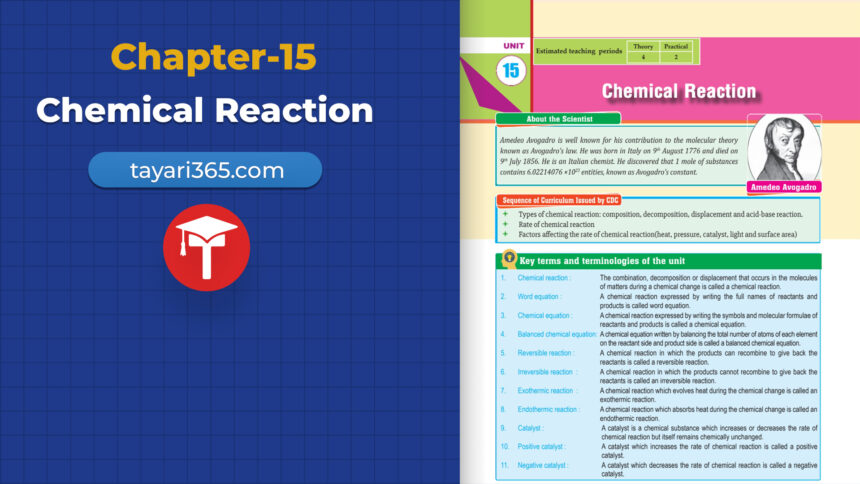
Class 10 Science Chapter 15 Chemical Reaction is one of the most essential and exam-important chapters in your science syllabus. In this chapter, you will explore what chemical reactions are, how to write and balance chemical equations, the different types of chemical reactions including combination, decomposition, displacement, and neutralization, as well as the major factors that affect the rate of a chemical reaction. From understanding why rusting of iron is a slow chemical reaction to learning how a catalyst speeds up reactions without being consumed, this complete guide to Class 10 Science Chapter 15 Chemical Reaction will help you master every concept with clarity and confidence.
1. Introduction to Chemical Reaction
- A chemical reaction is a process where one or more substances (reactants) are transformed into new substances (products) with different chemical properties.
- In a chemical reaction, bonds between atoms are broken and new bonds are formed, resulting in new compounds or elements.
2. Chemical Equation
A chemical equation represents a chemical reaction using symbols and formulas.
a. Word Equation
- In a word equation, the names of the reactants and products are written.
Examples:
- Hydrogen + Oxygen → Water
- Magnesium + Oxygen → Magnesium oxide
b. Formula Equation
- In a formula equation, chemical formulas are used to represent the substances involved.
Examples:
- H₂ + O₂ → H₂O
- Mg + O₂ → MgO
3. Balanced Chemical Equation
- A balanced chemical equation has equal numbers of each type of atom on both sides of the equation, satisfying the Law of Conservation of Mass.
Examples:
- H₂ + O₂ → H₂O ❌ (unbalanced)
2H₂ + O₂ → 2H₂O - Fe + O₂ → Fe₂O₃ ❌
4Fe + 3O₂ → 2Fe₂O₃ - Zn + HCl → ZnCl₂ + H₂ ❌
Zn + 2HCl → ZnCl₂ + H₂
4. Types of Chemical Reactions
a. Combination / Addition / Synthesis Reaction
- Two or more substances combine to form a single product.
General form: A + B → AB
Examples:
- C + O₂ → CO₂
- 2H₂ + O₂ → 2H₂O
- N₂ + 3H₂ → 2NH₃
b. Decomposition / Dissociation Reaction
- A single compound breaks down into two or more simpler substances.
General form: AB → A + B
Examples:
- CaCO₃ → CaO + CO₂
- 2H₂O → 2H₂ + O₂ (Electrolysis)
- 2KClO₃ → 2KCl + 3O₂
c. Displacement / Replacement Reaction
i. Single Displacement Reaction
- One element replaces another less reactive element in a compound.
General form: A + BC → AC + B
Examples:
- Zn + 2HCl → ZnCl₂ + H₂
- Fe + CuSO₄ → FeSO₄ + Cu
ii. Double Displacement Reaction
- Two compounds exchange ions or elements to form two new compounds.
General form: AB + CD → AD + CB
Examples:
- NaCl + AgNO₃ → NaNO₃ + AgCl
- BaCl₂ + Na₂SO₄ → BaSO₄ + 2NaCl
d. Acid-Base Reaction (Neutralization Reaction)
- An acid reacts with a base to produce salt and water.
General form: Acid + Base → Salt + Water
Examples:
- HCl + NaOH → NaCl + H₂O
- H₂SO₄ + Ca(OH)₂ → CaSO₄ + 2H₂O
Rate of Chemical Reaction – Class 10 Science Chapter 15 Chemical Reaction
- The rate of a chemical reaction is the speed at which reactants are converted into products.
- It depends on various physical and chemical factors.
Major Factors Affecting Reaction Rate:
- Temperature
- Increasing temperature increases the kinetic energy of particles → more effective collisions → faster reaction.
- Concentration of Reactants
- Higher concentration = more particles = more collisions = faster reaction.
- Surface Area of Reactants
- Finely divided or powdered reactants react faster due to more exposed surface.
- Catalyst
- A catalyst lowers the activation energy required for the reaction without being consumed itself.
- Nature of Reactants
- Some elements or compounds react more quickly based on their chemical properties (e.g., alkali metals are more reactive than transition metals).
- Pressure (for gaseous reactions)
- Increased pressure forces gas particles closer together, increasing the rate of collisions.
- Light (in photochemical reactions)
- Light can initiate or speed up certain reactions, like photosynthesis or decomposition of silver salts.
Key Terms to Remember
- Reactants – substances that undergo change.
- Products – new substances formed.
- Exothermic reaction – releases heat (e.g., combustion).
- Endothermic reaction – absorbs heat (e.g., photosynthesis).
- Catalyst – a substance that speeds up a reaction without being used up.
Did You Know?
- Fireflies glow due to a chemical reaction called bioluminescence, where an enzyme called luciferase reacts with luciferin in the presence of oxygen.
- Rusting of iron is a slow chemical reaction — it’s actually oxidation where iron reacts with water and oxygen to form iron oxide.
- The elephant toothpaste experiment is a dramatic example of a decomposition reaction involving hydrogen peroxide and potassium iodide.
- Instant cold packs use an endothermic reaction, where ammonium nitrate dissolves in water and absorbs heat — making the pack feel cold.
- Candle flames have different colors because of different temperatures and incomplete combustion reactions.
This completes the full revision of Class 10 Science Chapter 15 Chemical Reaction.