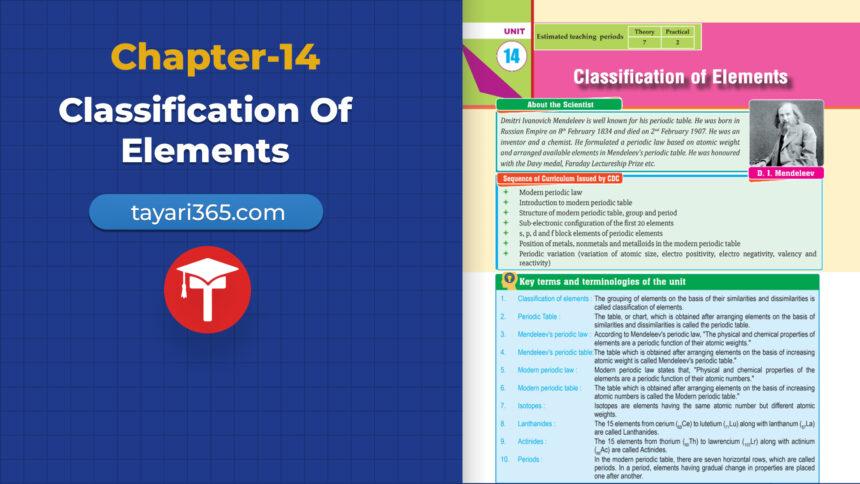
Class 10 Science Chapter 14 Classification of Elements is one of the most fundamental and scoring chapters in your science syllabus. In this chapter, you will explore why elements are classified, Mendeleev’s Periodic Table and its limitations, the Modern Periodic Table introduced by Henry Moseley, blocks and sub-shells, periodic trends across periods and groups, and the chemical reactivity of elements. From understanding why hydrogen has a unique position in the periodic table to learning how atomic size and electronegativity change across periods, this complete guide to Class 10 Science Chapter 14 Classification of Elements will help you master every concept with clarity and confidence.
1. Introduction to Classification of Elements
- Elements are pure substances consisting of only one type of atom.
- As the number of known elements increased (now over 118), it became necessary to classify them to study their properties efficiently.
2. Why Are Elements Classified?
- To group elements with similar properties together.
- To predict the properties of unknown elements.
- To make the study of chemical behavior and reactions systematic and easier.
- To understand the periodic trends like atomic size, valency, reactivity, etc.
3. Periodic Table
- A periodic table is a systematic arrangement of elements in rows and columns based on their atomic number, electronic configuration, and chemical properties.
- The modern periodic table is the most widely accepted format.
4. Mendeleev’s Periodic Table
- Introduced by Dmitri Mendeleev in 1869.
- Arranged elements in order of increasing atomic mass.
- Elements with similar properties were placed in vertical columns (groups).
Salient Features of Mendeleev’s Table:
- Consisted of 63 elements.
- Left gaps for undiscovered elements (like Gallium, Scandium).
- Correctly predicted properties of unknown elements.
- Placed elements with similar properties in the same group.
Demerits of Mendeleev’s Table:
- The position of isotopes was not clear.
- Hydrogen did not fit well in any group.
- Inconsistencies in placing elements strictly based on atomic mass (e.g., Ar before K).
- No separate place for lanthanides and actinides.
- The properties of transition elements were not clearly distinguished.
5. Modern Periodic Table
- Developed after Mendeleev and based on atomic number instead of atomic mass.
- Introduced by Henry Moseley in 1913.
- Also known as the Long Form Periodic Table.
6. Correction of Defects by Modern Periodic Table
a. Atomic Number:
- Atomic number (number of protons) is used as the basis for arrangement—resolves irregularities of atomic mass.
b. Position of Hydrogen:
- Can be placed in Group 1 (like alkali metals) or Group 17 (like halogens), depending on context.
c. Noble Gases:
- A separate Group 18 is provided for noble gases (Helium, Neon, etc.).
d. Transition Metals:
- Properly placed in the middle of the table (Groups 3–12).
e. Lanthanides and Actinides:
- Placed in two separate rows at the bottom of the table.
f. Isotopes:
- All isotopes have the same atomic number and thus occupy one position in the table.
g. Periodic Law Correction:
- Modern Periodic Law: “The properties of elements are the periodic function of their atomic numbers.”
h. Alkali and Coinage Metals:
- Alkali metals (Li, Na, K, etc.) placed in Group 1.
- Coinage metals (Cu, Ag, Au) placed in Group 11, with distinct properties.
7. Periods in the Modern Periodic Table
- Periods are horizontal rows in the periodic table.
- There are 7 periods.
- Period number indicates the number of shells in the atom of the element.
Examples:
- 1st period: H, He (1 shell)
- 2nd period: Li to Ne (2 shells)
8. Groups in the Modern Periodic Table
- Groups are vertical columns in the periodic table.
- There are 18 groups.
- Group number indicates the number of valence electrons (in representative elements).
- Elements in the same group have similar chemical properties.
9. Sub-Shells (Brief Overview)
- Sub-shells are parts of electron shells.
- Named as s, p, d, f.
- These determine the electronic configuration and block position of elements.
Capacity of sub-shells:
- s: 2 electrons
- p: 6 electrons
- d: 10 electrons
- f: 14 electrons
10. Aufbau Principle
- States that electrons fill atomic orbitals in order of increasing energy.
- Order: 1s < 2s < 2p < 3s < 3p < 4s < 3d < 4p…
Blocks in the Modern Periodic Table – Class 10 Science Chapter 14 Classification of Elements
Based on which sub-shell is being filled with electrons.
| Block | Sub-shell | Group Range | Type of Elements |
| s | s | 1 and 2 | Alkali and alkaline earth metals |
| p | p | 13 to 18 | Nonmetals, metalloids, noble gases |
| d | d | 3 to 12 | Transition metals |
| f | f | Lanthanides and Actinides | Inner transition metals |
12. Properties of Periods and Groups
Across a Period (left to right):
- Atomic size decreases
- Electronegativity increases
- Ionization energy increases
- Metallic character decreases
- Non-metallic character increases
Down a Group:
- Atomic size increases
- Electronegativity decreases
- Ionization energy decreases
- Metallic character increases
- Non-metallic character decreases
13. Chemical Reactivity of Elements
- Metals: Lose electrons easily (more reactive down the group).
- Non-metals: Gain electrons (more reactive up the group).
- Noble gases: Chemically inert due to full valence shells.
This completes the full revision of Class 10 Science Chapter 14 Classification of Elements.