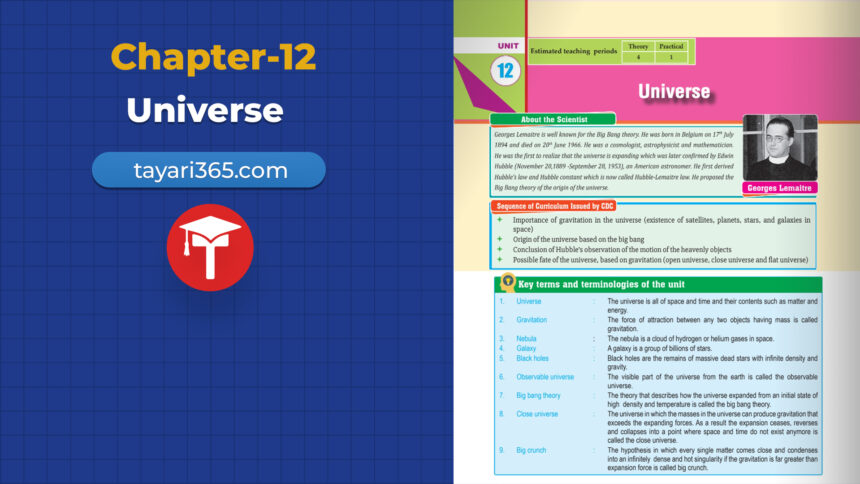
Class 10 Science Chapter 12 The Universe is one of the most mind-expanding and awe-inspiring chapters in your science syllabus. In this chapter, you will explore the origin of the universe through the Big Bang Theory, Hubble’s Law, the role of gravitational force in space, centripetal and centrifugal forces, mean and critical density, and the possible futures of the universe. From understanding why galaxies are moving away from us to learning what determines whether the universe will expand forever or collapse, this complete guide to Class 10 Science Chapter 12 The Universe will help you master every concept and formula with clarity and confidence.
1. What is the Universe?
The universe is the totality of space, time, matter, and energy. It includes:
- Galaxies, stars, planets, moons, black holes
- All forms of radiation and dark matter/energy
- Estimated age: 13.8 billion years
- Contains billions of galaxies, each with millions to billions of stars
2. Importance of Gravitational Force in the Universe
Gravitational force is the fundamental force that:
- Holds planets in orbit around stars
- Binds galaxies and galaxy clusters together
- Controls the motion of celestial bodies
- Played a major role in the formation of stars, galaxies, and planetary systems
- Prevents matter in the universe from expanding forever unchecked
Without gravity, no stars, planets, or life could exist.
3. Study of the Universe (Cosmology)
The scientific study of the universe is called cosmology.
Scientists and astronomers use:
- Telescopes (optical, radio, space-based like Hubble)
- Spectroscopy (studying light spectra from stars/galaxies)
- Satellites and space probes
- Mathematical models and simulations
4. Big Bang Theory
- The most accepted origin theory of the universe
- States the universe began as a singular point of infinite density (~13.8 billion years ago)
- This point expanded rapidly – not an explosion, but a rapid expansion of space itself
- As expansion occurred, matter cooled and formed galaxies and stars
Evidence for Big Bang:
- Redshift of galaxies (expansion)
- Cosmic microwave background radiation (CMBR)
- Abundance of light elements (hydrogen and helium)
5. Hubble’s Study Regarding the Universe
Edwin Hubble (1920s)
- Observed that galaxies are moving away from us.
- The farther a galaxy is, the faster it moves away.
This led to the formulation of Hubble’s Law.
6. Hubble’s Law
Hubble’s Law:
v = H0 × d
Where:
v = recessional velocity
H0 = Hubble’s constant
d = distance of galaxy
Where:
- vvv = velocity at which a galaxy is receding
- H0H_0H0 = Hubble’s constant (approx. 70 km/s per megaparsec)
- ddd = distance of the galaxy
Meaning:
The universe is expanding. Every galaxy is moving away from every other galaxy.
Possible Futures – Class 10 Science Chapter 12 The Universe
The fate of the universe depends on the balance between expansion force and gravitational force:
a. Continuous Expansion (Open Universe)
- Expansion continues forever
- Galaxies move farther and farther
- The universe becomes cold and dark
b. Slowing Expansion → Balance (Flat Universe)
- Expansion slows but never fully stops
- Critical density is just right
- Universe expands infinitely at a decreasing rate
c. Contraction (Closed Universe)
- Gravity overcomes expansion
- Universe eventually collapses → Big Crunch
8. Role of Centripetal & Centrifugal Forces in Existence of Heavenly Bodies
Centripetal Force:
- Pulls celestial bodies towards the center
- Provided by gravitational attraction
Centrifugal Force:
- Tendency of a rotating body to move away from the center
- Acts outward, due to orbital motion
These two forces are in balance, keeping:
- Planets in orbit around the sun
- Moons orbiting planets
- Galaxies stable
If centripetal > centrifugal → inward collapse
If centrifugal > centripetal → escape from orbit
9. Mean Density & Critical Density
Mean Density of the Universe:
The average density of all matter (including dark matter)
Mean Density of the Universe:
ρmean = (total mass of universe) / (volume of universe)
Critical Density:
- The exact density needed to stop the expansion of the universe over infinite time
Critical Density Formula:
ρc = (3 × H02) / (8 × π × G)
Where:
H0 = Hubble’s constant
G = Gravitational constant
10. Comparing Mean Density and Critical Density
| Condition | Resulting Universe Type |
|---|---|
| ρmean > ρc | Closed Universe (collapses) |
| ρmean = ρc | Flat Universe (balanced) |
| ρmean < ρc | Open Universe (expands forever) |
11. Types of the Universe (Based on Density)
Flat Universe
- Infinite, but gravity balances expansion
- Universe expands slowly forever
Open Universe
- Infinite and keeps expanding rapidly
- Cold, dark future
Closed Universe
- Finite and curves back on itself
- Eventually contracts → Big Crunch
Interesting Facts about the Universe
- The observable universe is about 93 billion light years across!
- Dark energy makes up ~70% of the universe, and it’s driving the accelerated expansion.
- Galaxies are not expanding themselves, only space between them is.
- The James Webb Space Telescope allows scientists to study the earliest galaxies, close to Big Bang time.
- Neutron stars are so dense that 1 teaspoon of their material would weigh billions of tons on Earth.
Quick Revision
- Universe: All matter and energy
- Gravity: Binds structures in space
- Big Bang: Universe began as dense point
- Hubble’s Law: Expansion → v = H₀·d
- Fate of Universe: Depends on mean vs critical density
- Types of Universes: Open, flat, closed
This completes the full revision of Class 10 Science Chapter 12 The Universe.