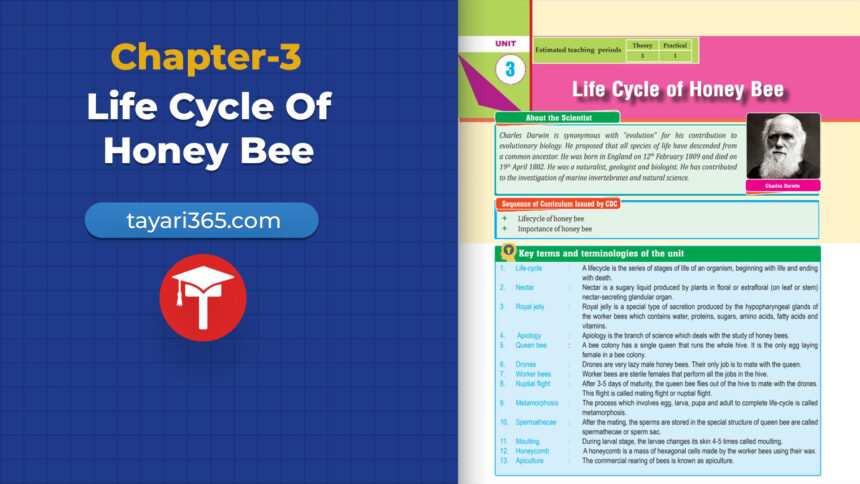
Class 10 Science Chapter 3 Life Cycle of Honey Bee is one of the most fascinating and practical chapters in your science syllabus. In this chapter, you will explore the complete life cycle of honey bees, their caste system, division of labour, method of honey production, and the importance of apiculture. From understanding how a larva transforms into a queen bee to learning why bees are essential for our food supply, this complete guide to Class 10 Science Chapter 3 Life Cycle of Honey Bee will help you master every concept clearly and confidently.
1. Introduction to Honey Bee
Honey Bee are social insects that live in highly organized colonies. They play a vital role in pollination, honey production, and maintaining ecological balance.
• Class: Insecta | Order: Hymenoptera
• Colonies exhibit a well-defined division of labor
• Show eusocial behavior, the highest level of social organization among animals
Interesting Fact: Fossil evidence suggests honey bees have existed for over 30 million years.
2. Apiculture and Its Importance
➤ What is Apiculture?
Apiculture refers to the rearing and management of honey bees for obtaining honey, wax, and pollination services.
Importance of Apiculture
- Provides economic benefits through the sale of honey and wax
- Enhances agricultural productivity through pollination
- Creates employment opportunities, especially in rural areas
- Supports sustainable and eco-friendly agriculture
3. Structure of Honey Bees
The body of a honey bee is divided into three main parts:
- Head – Contains compound eyes, antennae, and mouthparts for sensing and feeding
- Thorax – Bears three pairs of legs and two pairs of wings
- Abdomen – Houses the digestive and reproductive systems
4. Types of Honey Bees in a Colony
| Type of Bee | Number | Lifespan | Function |
| Queen Bee | 1 | 2–5 years | Lays eggs and secretes pheromones |
| Drone Bees | ~100 | Few weeks | Fertilize the queen during mating |
| Worker Bees | Thousands | 5–6 weeks | Perform all other tasks in the colony |
Memory Tip: Q–D–W = Queen (reproduction), Drone (fertilization), Worker (maintenance and foraging)
5. Life Cycle of Honey Bee
Honey bees undergo complete metamorphosis consisting of four stages:
Egg → Larva → Pupa → Adult
1. Egg 🥚
• Laid by the queen bee into a cell of the honeycomb
• Small, elongated, and white in color
• Hatches within approximately 3 days
2. Larva 🐛
• White, legless, and worm-like stage
• Fed by worker bees with royal jelly, a nutrient-rich substance
What is Royal Jelly?
A protein-rich secretion produced by glands in worker bees.
• All larvae are fed royal jelly for the first 3 days
• Larvae destined to become queens continue receiving royal jelly throughout the larval stage
3. Pupa
• The larva spins a cocoon and undergoes transformation
• Development of legs, wings, eyes, and other adult features
• Pupal stage duration varies by caste:
– Queen: ~7 days
– Worker: ~12 days
– Drone: ~14 days
4. Adult
• Emerges by chewing through the wax cap of the cell
• Takes on a specific role depending on caste (queen, drone, or worker)
• Starts performing colony-specific tasks
6. Division of Labour in Honey Bees
Worker bees perform age-based duties in the colony – a phenomenon known as age-related polyethism.
| Age (Days) | Task Performed |
| 1–3 | Cleaning hive cells |
| 4–6 | Feeding larvae |
| 7–10 | Producing royal jelly |
| 11–18 | Building comb and guarding the hive |
| 19+ | Foraging for nectar and pollen |
Interesting Fact: Each task transition is triggered by hormonal changes and colony needs.
Method of Honey Production – Class 10 Science Chapter 3 Life Cycle of Honey Bee
- Forager bees collect nectar from flowers using their proboscis
- Nectar is stored in a special stomach called the honey sac
- It is mixed with digestive enzymes and brought back to the hive
- Bees deposit nectar into honeycomb cells
- Moisture is reduced by wing fanning, converting nectar into honey
- Finally, cells are sealed with a wax cap to preserve the honey
8. Major Uses of Honey Bees
1. Honey – Used as a natural sweetener and in traditional medicine
2. Beeswax – Essential for making candles, cosmetics, and polishes
3. Pollination – Increases productivity of fruits, vegetables, and oilseeds
4. Royal Jelly – Used in health supplements for its nutritional properties
5. Propolis – Resin-like substance used in folk medicine for its antimicrobial qualities
Interesting Fact: About one-third of the world’s food production depends on bee pollination.
Interesting Facts about Honey Bees
- Honey bees can flap their wings up to 200 times per second
- A single bee produces approximately 1/12 teaspoon of honey in its lifetime
- Honey is naturally antimicrobial and does not spoil
- A queen bee can lay up to 2,000 eggs per day during peak season
Quick Revision Summary
- Honey bees are eusocial insects with a defined caste system
- Apiculture is the practice of beekeeping for honey and pollination
- Life cycle: Egg → Larva → Pupa → Adult (complete metamorphosis)
- Worker bees change roles with age (age-related polyethism)
- Honey is produced from nectar using enzymes and evaporation
- Honey bees support both the economy and the environment
Common Mistakes to Avoid
- Assuming all bees can lay eggs – only the queen can
- Confusing the roles of drone and worker bees
- Forgetting the function of royal jelly in queen development
- Mixing up the larval and pupal stages
This completes the full revision of Class 10 Science Chapter 3 Life Cycle of Honey Bee.