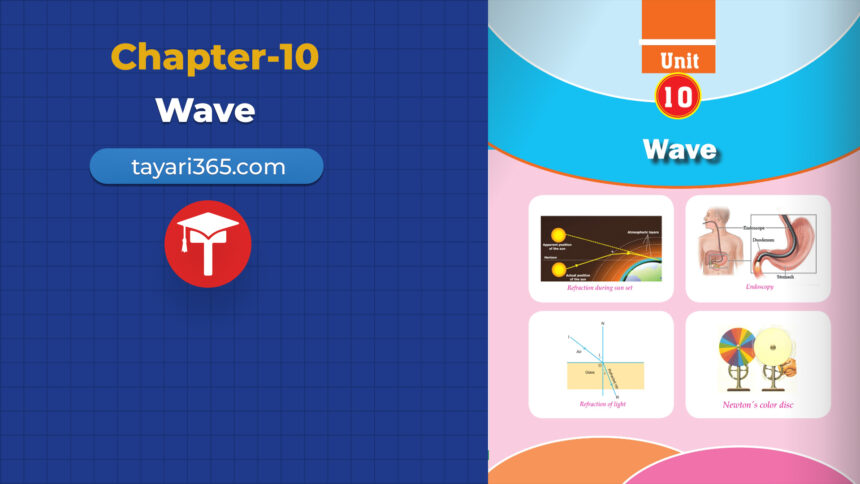
Class 10 Science Chapter 10 Wave is one of the most fascinating and concept-rich chapters in your science syllabus. In this chapter, you will explore refraction of light, Snell’s Law, total internal reflection, dispersion of light, image formation by lenses, the structure of the human eye, defects of vision, and modern eye correction methods like LASIK. From understanding why stars twinkle to learning how optical fibers carry internet signals across the world, this complete guide to Class 10 Science Chapter 10 Wave will help you master every concept and diagram with clarity and confidence.
1. Introduction to Wave and Light
- Waves are disturbances that transmit energy through a medium (like water or air) or no medium (like light in space).
- Light is an electromagnetic wave, meaning it can travel through a vacuum and doesn’t require a medium.
2. Denser Medium vs Rarer Medium
- Denser medium: where light slows down (e.g., glass, water)
- Rarer medium: where light speeds up (e.g., air, vacuum)
- This change in speed causes refraction (bending) of light.
3. Refraction of Light
3.1 Causes of Refraction
- Light travels slower in denser media (lower speed) → it bends toward the normal.
- In rarer media, it bends away from the normal.
3.2 Refraction through a Glass Slab
- A light ray entering the slab bends toward the normal.
- Upon exiting, it bends away from the normal, emerging parallel to the incident ray but displaced sideways.
3.3 Terminology Related to Refraction
- Incident Ray: Incoming light
- Angle of Incidence (i): Between incident ray & normal
- Refracted Ray: Ray inside new medium
- Angle of Refraction (r): Between refracted ray & normal
- Normal: Perpendicular at point of incidence
- Emergent Ray: Exits the medium
- Emergent Angle (e): Between emergent ray & normal
3.4 Laws of Refraction (Snell’s Laws)
- Incident ray, refracted ray, and normal lie in the same plane.
- Snell’s Law (Refraction)
- sin i / sin r = constant = n
- Where:
- i = Angle of incidence
- r = Angle of refraction
- n = Refractive index of the medium
Refractive Index (n)
The refractive index is the ratio of the speed of light in air to its speed in a medium, or the ratio of the sine of angles of incidence and refraction:
n = sin i / sin r = vair / vmedium
Where:
- i = Angle of incidence
- r = Angle of refraction
- vair = Speed of light in air
- vmedium = Speed of light in the medium
Typical values:
- n (water) ≈ 1.33
- n (glass) ≈ 1.5
5. Consequences of Refraction
A) At Water–Air Interface
- Apparent depth: Objects look shallower when underwater.
- Stick-in-water effect: A stick appears bent at water’s surface.
B) Atmospheric Refraction
- Sunrise/Sunset: Visible even when sun below horizon due to bending.
- Twinkling of stars: Caused by air layers bending light randomly.
- Looming: Distant objects appear floating or higher.
- Distorted sunsets/moonrises: Appear flattened or stretched.
- Daylight stars/planets: Rarely seen due to extreme refraction at horizon.
- Improved visibility: Refraction over heated ground creates mirages.
6. Total Internal Reflection (TIR) & Critical Angle
- Critical angle: Minimum angle of incidence in denser medium above which TIR occurs.
- Condition for Total Internal Reflection
- : Light must travel from a denser to a rarer medium, and the angle of incidence (i) must be greater than the critical angle (θc).
- i > θc
- Only under this condition will total internal reflection occur.
- Critical angle formula:
Critical Angle Formula
sin θc = n₂ / n₁
Where:
- θc = Critical angle
- n₁ = Refractive index of denser medium
- n₂ = Refractive index of rarer medium
This formula is valid only when light travels from a denser to a rarer medium.
A) Consequences of TIR
- Sparkling diamonds: Light trapped inside, then ejected through facets.
- Bright air-bubble surfaces: TIR inside the bubble.
- Mirages: Light reflects within warm air layers, showing false water.
B) Applications of TIR
- Optical fibers:
- Structure: Transparent core, cladding with lower refractive index.
- Working: Light reflects inside core with TIR, travels long distances.
- Uses: Telecommunication (internet, cable TV), endoscopy in medicine, surgical imaging.
- Endoscopy Breakdown:
- Uses optical fibers to carry light into the body.
- Allows doctors to see internal organs.
- Enables minimally invasive (keyhole) surgery.
7. Dispersion of Light
- Dispersion: White light decomposes into colors (ROYGBIV) when passing through a prism.
- Cause: Each color has a different refractive index → bends differently.
- Example: Rainbows—sunlight disperses and reflects inside raindrops forming colored arc.
8. Lenses & Image Formation
8.1 Lens Terminology
- Principal Axis: Central straight line through lens
- Optical Centre (O): Point where light passes undeviated
- Centre of Curvature: Centre of the original sphere of which lens is part
- Principal Focus (F): Point where parallel incident rays converge (convex) or appear to diverge from (concave)
- Focal Length (f): Distance from O to F
8.2 Types of Lenses
- Convex (Converging): Thicker in middle
- Concave (Diverging): Thicker at edges
8.3 Light-Ray Rules
- Parallel ray → passes through focus
- Focus-ray → emerges parallel
- Centre-ray → passes straight
8.4 Image Formation by Convex Lens
| Object Position | Image Position & Nature |
| At Infinity | At F, real, inverted, highly diminished |
| Beyond 2F | Between F & 2F, real, inverted, diminished |
| At 2F | At 2F, real, inverted, same size |
| Between F & 2F | Beyond 2F, real, inverted, enlarged |
| At F | No image (rays parallel) |
| Between F & O | Virtual, upright, enlarged |
8.5 Concave Lens
- Always produces virtual, upright, reduced image between lens and focus.
8.6 Lens Power
Power of a Lens
P = 1⁄f (m)
Where:
P = Power of the lens (in diopters)
f = Focal length (in meters)
- Positive → Convex lens
- Negative → Concave lens
Human Eye – Class 10 Science Chapter 10 Wave
- Cornea: Transparent front surface; aids focusing
- Pupil: Adjustable aperture controls light entry
- Lens: Focuses light on retina
- Ciliary Muscles: Adjust lens shape (accommodation)
- Retina: Contains photoreceptors (rods/cones)
- Optic Nerve: Transmits images to brain
9.1 Understanding Accommodation
- Distant vision: Lens flattens using ciliary relaxation
- Near vision: Lens thickens using ciliary contraction
9.2 Far Point & Near Point
- Far point (D): Farthest distance seen clearly (∞ in normal eye)
- Near point: Closest distance seen clearly (25 cm typical)
10. Defects of Vision & Corrections
A) Myopia (Near-sighted)
- Light focuses before retina
- Caused by elongated eyeball or strong lens
- Corrected with concave lens
B) Hypermetropia (Far-sighted)
- Light focuses behind retina
- Caused by short eyeball or weak lens
- Corrected with convex lens
11. Alternatives to Spectacles
a) Contact Lenses
- Thin lenses on cornea for vision correction
- Advantages: More natural vision
- Use: Cleanliness essential to avoid infection
b) Laser Eye Surgery
- Reshapes cornea permanently
- LASIK: Cuts flap, reshapes deeper layer
- PRK: Reshapes surface layer
- Pros: No glasses needed
- Cons: Costly, slight risks of dry eyes/irregular vision
12. Other Eye Conditions
a) Cataract
- Cloudy lens leading to blurred vision
- Treated via surgical lens replacement
b) Night Blindness
- Difficulty seeing in dim light
- Caused by deficiency in vitamin A
- Treatment: Dietary improvement (carrots, leafy vegetables)
c) Colour Blindness
- Genetic inability to distinguish colors (often red-green)
- No cure, but lenses and apps can help
d) Corneal Injuries
- Corneal ulcer: infection on the cornea
- Corneal edema: swelling
- Keratoconus: cornea shape change
- Corneal transplant: replacing damaged cornea
Interesting Facts
- The cornea has no blood vessels; it gets oxygen directly from air.
- LASIK reshaping takes under 10 minutes per eye.
- A rainbow is a full circle; we usually see only the top half.
- Optical fibers can transmit light signals across the world with <1% loss per kilometer.
Quick Revision Summary
- Refraction: Light bends entering a denser/rarer medium
- TIR: Full reflection inside dense medium; lens basis of fiber optics
- Dispersion: White light splits into colors
- Lens rules produce varied image types; power derived from focal length
- Eye: adjusts via accommodation, can be corrected by lenses or surgery
- Includes cataract, night blindness, colour blindness, and cornea issues
Common Mistakes
- Confusing emergence and incident angles
- Misidentifying virtual vs real rays in lens diagrams
- Labeling defects incorrectly (e.g. using concave for hypermetropia)
- Forgetting negative vs positive lens power
- Misunderstanding accommodation process
This completes the full revision of Class 10 Science Chapter 10 Wave.