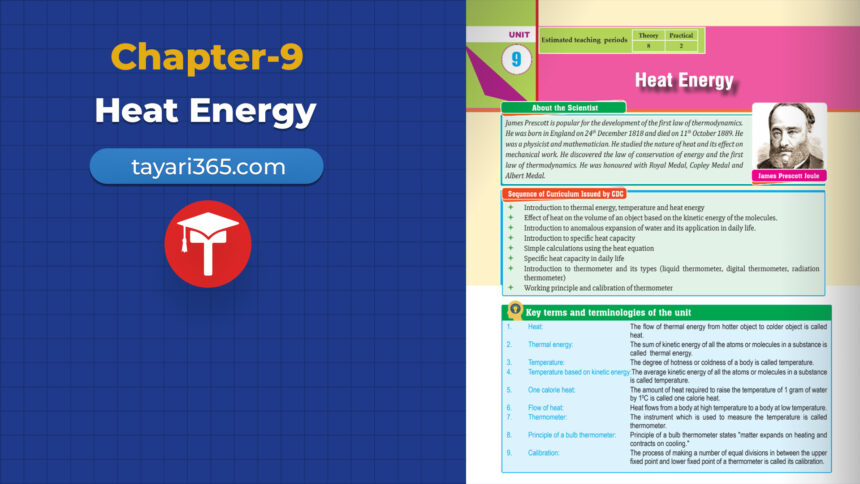
Class 10 Science Chapter 9 Heat is one of the most formula-rich and conceptually important chapters in your science syllabus. In this chapter, you will explore thermal energy, the difference between heat and temperature, thermal expansion, anomalous expansion of water, specific heat capacity, calorimetry, and types of thermometers. From solving heat energy numerical problems using Q = mcΔT to understanding why aquatic life survives in frozen lakes, this complete guide to Class 10 Science Chapter 9 Heat will help you master every concept and calculation with clarity and confidence.
Chapter-9
1. Thermal Energy, Heat, and Temperature
- Thermal Energy: Total internal energy of all particles in a substance due to their motion.
- Heat: Energy transferred from a hotter object to a cooler one.
- Temperature: A measure of the degree of hotness or coldness of an object.
Difference between Heat and Temperature
| Heat | Temperature |
| Energy in transit | Degree of hotness |
| Depends on mass and material | Independent of mass |
| SI unit: Joule (J) | SI unit: Kelvin (K) |
| Measured with calorimeter | Measured with thermometer |
2. Effect of Heat on Volume (Thermal Expansion)
When heat is supplied, substances expand.
Expansion by State:
- Solids: Expand slightly
- Liquids: Expand more than solids
- Gases: Expand the most
Examples:
- Railway tracks bend in summer
- Electric wires sag when hot
- Bottles bulge when heated
3. Anomalous Expansion of Water
- Water contracts from 100°C to 4°C
- Expands below 4°C until it freezes
- This is anomalous (unusual) behavior
Implications:
- Ice floats on water
- Aquatic life survives in frozen lakes
- Surface freezes first; bottom remains liquid
Applications:
- Cooling systems
- Lake ecosystems
- Climate regulation
4. Specific Heat Capacity
Definition:
Heat required to raise the temperature of 1 kg of a substance by 1°C
Heat Energy Formula
Q = mcΔT
Where:
- Q = Heat energy (Joules)
- m = Mass (kg)
- c = Specific heat capacity (J/kg°C)
- ΔT = Temperature change (°C)
Water:
- High specific heat = 4200 J/kg°C
Uses:
- Car radiators
- Hot water bottles
- Climate moderation (coastal areas)
5. Factors Affecting Heat Absorption
- Color: Dark surfaces absorb more
- Surface area: Larger = more heat gain
- Material: Different capacities
- Mass: More mass = more heat needed
- Specific heat: Substances vary
6. Heat Equation & Sample Numerical
Heat Energy Formula
Q = mcΔT
Where:
- Q = Heat energy (Joules)
- m = Mass (kg)
- c = Specific heat capacity (J/kg°C)
- ΔT = Temperature change (°C)
Example:
Find the heat needed to raise 2 kg of water from 20°C to 60°C.
Q = 2 × 4200 × (60 − 20) = 336,000 J
Answer: 336,000 Joules
Calorimetry and Its Principle – Class 10 Science Chapter 9 Heat
- Calorimetry: The science of measuring heat changes
- Principle:
Heat Exchange Principle
Heat lost by hot object = Heat gained by cold object
m₁c₁(T₁ − Tf) = m₂c₂(Tf − T₂)
Where:
- m₁, m₂ = Mass of hot and cold objects
- c₁, c₂ = Specific heat capacities
- T₁ = Initial temperature of hot object
- T₂ = Initial temperature of cold object
- Tf = Final equilibrium temperature
🔢 Worked Example: Heat Exchange
Problem: A 1 kg copper block at 100°C is placed in 2 kg of water at 30°C.
Given:
- Mass of copper = 1 kg
- Initial temperature of copper = 100°C
- Specific heat of copper = 390 J/kg°C
- Mass of water = 2 kg
- Initial temperature of water = 30°C
- Specific heat of water = 4200 J/kg°C
Equation:
(1)(390)(100 − T) = (2)(4200)(T − 30)
Step 1: Expand both sides
390(100 − T) = 39000 − 390T
8400(T − 30) = 8400T − 252000
Step 2: Set both sides equal
39000 − 390T = 8400T − 252000
Step 3: Solve for T
Bring variables to one side:
39000 + 252000 = 8400T + 390T
291000 = 8790T
T = 291000 ÷ 8790 ≈ 33.1°C
✅ Final Answer: T ≈ 33.1°C
8. Types of Thermometers
| Type | Principle | Uses |
| Liquid Thermometer | Thermal expansion of mercury/alcohol | Household use |
| Digital Thermometer | Electronic sensors | Accurate and safe |
| Radiation Thermometer | Infrared detection | Remote sensing, industry |
9. Calibration of Thermometer
- Lower Fixed Point: 0°C (melting point of ice)
- Upper Fixed Point: 100°C (boiling point of water)
- Divided into 100 parts = Celsius scale
Interesting Facts
- Boiling water stays at 100°C at sea level
- Black surfaces heat up faster than white ones
- Water’s high specific heat stabilizes Earth’s climate
- Anomalous expansion of water helps fish survive in frozen lakes
Quick Revision Summary
- Heat flows from hot to cold
- Q = mcΔT
- Heat causes expansion
- Water has high specific heat
- Calorimetry: heat lost = heat gained
- Thermometers: types and uses
- Anomalous water behavior supports life
Common Mistakes to Avoid
- Mixing heat and temperature
- Forgetting to convert grams to kg
- Wrong application of heat formula
- Assuming all materials expand equally
- Confusing thermal energy with temperature
This completes the full revision of Class 10 Science Chapter 9 Heat.