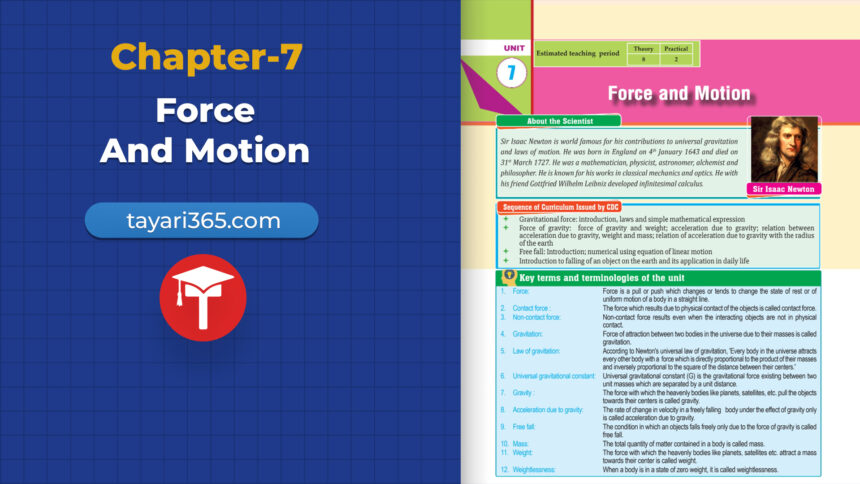
Class 10 Science Chapter 7 Force and Motion is one of the most important and numerical-rich chapters in your science syllabus. In this chapter, you will explore Newton’s Universal Law of Gravitation, acceleration due to gravity, the difference between mass and weight, free fall, and equations of motion under gravity. From calculating gravitational force between two objects to solving free fall problems step by step, this complete guide to Class 10 Science Chapter 7 Force and Motion will help you master every concept and formula with clarity and confidence.
1. Introduction Force and Motion
Force is a push or pull that can change the state of rest or motion of an object. This chapter focuses primarily on gravitational force, free fall, and motion under gravity.
2. Gravitational Force
Newton’s Universal Law of Gravitation
Every object in the universe attracts every other object with a force that is:
- Directly proportional to the product of their masses
- Inversely proportional to the square of the distance between them
Gravitational Force Formula
Formula:
F = G (m₁ × m₂) / r²
Where:
- F = Gravitational force (in newtons, N)
- G = Universal gravitational constant = 6.674 × 10⁻¹¹ Nm²/kg²
- m₁, m₂ = Masses of the two objects (in kilograms, kg)
- r = Distance between the centers of the two masses (in meters, m)
🔢 Worked Example 1
Gravitational Force Calculation.
Formula:
F = G × (m₁ × m₂) / r²
Given:
- m₁ = 10 kg
- m₂ = 20 kg
- r = 2 m
- G = 6.674 × 10⁻¹¹ Nm²/kg²
Solution:
F = 6.674 × 10−11 × (10 × 20) / 2²
F = 6.674 × 10−11 × 200 / 4
F = 6.674 × 10−11 × 50
F = 3.337 × 10⁻⁹ N
Answer: 3.34 × 10⁻⁹ N
3. Variation of Gravitational Force
A. With Mass:
- If one mass is doubled, force doubles.
- If both masses are doubled, force becomes four times.
- If both masses are halved, force becomes one-fourth.
B. With Distance:
- If distance is doubled, force becomes one-fourth.
- If distance is halved, force becomes four times.
4. Consequences of Gravitational Force
- Keeps planets in orbit
- Causes tides
- Responsible for free fall
- Keeps the atmosphere bound to Earth
5. Gravity and Acceleration Due to Gravity
The force by which Earth attracts objects toward its center.
Difference: Gravity vs. Gravitation
| Feature | Gravity | Gravitation |
| Scope | Between Earth and objects | Between any two masses |
| Nature | Earth-specific | Universal |
Acceleration Due to Gravity (g)
- Symbol and Value of Gravity
- Symbol: g
- Value on Earth: 9.8 m/s2
Weight–Mass Relationship
Weight Formula
W = mg
Where:
- W = Weight (in newtons, N)
- m = Mass (in kilograms, kg)
- g = Acceleration due to gravity (in meters per second squared, m/s²)
📌 Weight is proportional to mass and gravity.
Worked Example 2
Weight Calculation on Earth
Formula:
W = m × g
Given:
- m = 60 kg (mass of the person)
- g = 9.8 m/s² (acceleration due to gravity on Earth)
Calculation:
W = 60 × 9.8 = 588 N
Answer: 588 N
6. Acceleration Due to Gravity is Independent of Mass
In a vacuum, all objects fall with the same acceleration regardless of mass.
Example: Feather and coin fall equally when air resistance is removed.
7. Mass and Weight
| Feature | Mass | Weight |
| Definition | Quantity of matter | Force due to gravity |
| Unit | Kilogram (kg) | Newton (N) |
| Constant? | Yes | Varies with gravity |
| Type | Scalar | Vector |
8. Variation of g on Earth
- Highest at poles
- Lowest at equator
- Decreases with altitude and depth
Free Fall – Class 10 Science Chapter 7 Force and Motion
Motion of an object only under gravity, with no air resistance.
Occurs in vacuum or near-Earth free-fall environments.
10. Equations of Motion Under Gravity
Assume:
- Initial velocity = u
- Final velocity = v
- Distance = s
- Time = t
- Acceleration due to gravity = g
Equations:
- v = u + gt
- s = ut + ½gt²
- v² = u² + 2gs
Key Equations of Motion Under Gravity
- Displacement: s = ut + (1/2)gt²
- Final Velocity: v = u + gt
- Velocity–Displacement Relation: v² = u² + 2gs
📌 For objects falling from rest, use u = 0
Worked Example 3
Problem: An object falls freely from rest. Find the distance it covers in 3 seconds.
Given:
- Initial velocity, u = 0
- Acceleration due to gravity, g = 9.8 m/s²
- Time, t = 3s
Formula: s = ut + (1/2)gt²
Substitute values:
s = 0 × 3 + (1/2) × 9.8 × 3²
s = 0 + (1/2) × 9.8 × 9
s = 4.9 × 9 = 44.1 m
Answer: 44.1 meters
Interesting Facts
- Moon’s gravity is approximately 1/6th of Earth’s gravity. That means objects weigh about six times less on the Moon than on Earth.
- Astronauts feel “weightless” in orbit because they are in continuous free fall.
- Galileo demonstrated free fall from the Leaning Tower of Pisa.
Quick Revision Summary
Gravitational Concepts & Formulas
Acceleration due to gravity on Earth: g = 9.8 m/s²
• Free fall is motion under gravity alone
• Equations of motion apply during free fall
Gravitational Force: F = G × (m₁ × m₂) / r²
Weight: Weight = mass × gravity
Common Mistakes to Avoid
• Confusing mass and weight
• Forgetting units: mass in kg, weight in N
Note: Do not use g = 9.8 m/s² in places where it doesn’t apply, such as on the Moon or other celestial bodies.
• Mixing up gravity and gravitation
• Applying motion equations to situations that are not free fall
This completes the full revision of Class 10 Science Chapter 7 Force and Motion.