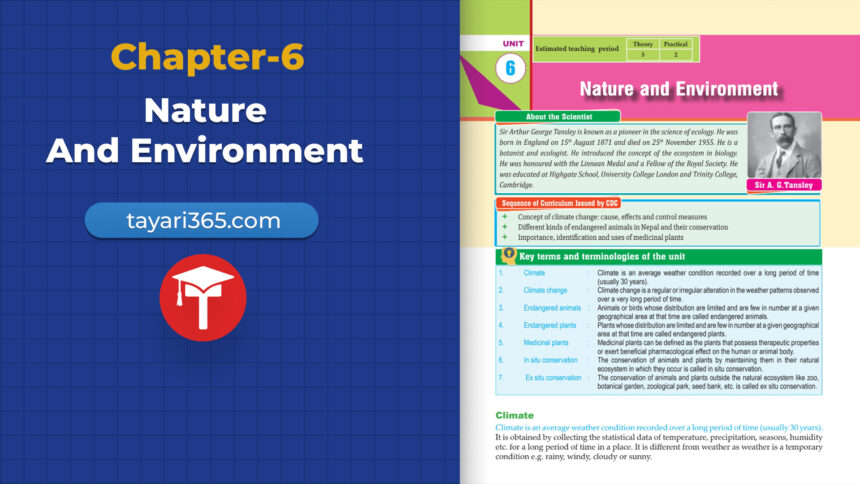
Class 10 Science Chapter 6 Nature and Environment is one of the most relevant and thought-provoking chapters in your science syllabus. In this chapter, you will explore the concept of climate and climate change, its natural and human-induced causes, Nepal’s endangered species, conservation strategies for rare plants and animals, protected species under Nepal’s wildlife act, and the rich diversity of medicinal plants found in Nepal. From understanding why glaciers are melting to learning how communities protect the one-horned rhinoceros, this complete guide to Class 10 Science Chapter 6 Nature and Environment will help you master every concept with awareness and confidence.
1. What is Nature and Environment?
- Nature includes all physical and biological entities such as forests, rivers, animals, and mountains.
- Environment refers to the surroundings in which living organisms exist. It includes both natural components and human-made structures.
2. Climate and Climate Change
2.1 Climate
Climate refers to the long-term average of weather patterns in a particular region.
2.2 Climate Change
Climate change is a significant and lasting alteration in climate patterns over decades or longer.
Causes of Climate Change
A. Natural Causes
- Solar Activity – Variations in the sun’s energy output
- Albedo Effect – Changes in reflectivity of Earth’s surface or cloud cover
- Volcanic Eruptions – Ash clouds can block sunlight, temporarily cooling Earth
B. Human-Induced Causes
- Emission of greenhouse gases (CO₂, CH₄)
- Deforestation
- Industrialization and burning of fossil fuels
Effects of Climate Change
- Rising global temperatures
- Melting glaciers and sea level rise
- Increased frequency of extreme weather events
- Loss of biodiversity
- Disruption of agriculture and food security
Control Measures
- Reducing emissions of greenhouse gases
- Protecting forests and promoting afforestation
- Using energy-efficient technologies
- Practicing the 3Rs: Reduce, Reuse, Recycle
- Raising public awareness through education
3. Endangered Species of Nepal
Mammals and Birds of Concern
- Mammals: Bengal Tiger, One-Horned Rhinoceros, Snow Leopard, Red Panda, Chinese Pangolin, Gharial
- Birds: White-Rumped Vulture, Spiny Babbler
Reasons for Endangerment
- Loss of habitat
- Poaching and illegal hunting
- Pollution
- Climate change
- Invasive species
4. Conservation of Endangered and Rare Plants in Nepal
Major Methods:
- Establishment of Protected Areas (e.g., national parks, reserves)
- Reforestation and habitat restoration
- Ex situ conservation in botanical gardens and seed banks
- Involving local communities in conservation efforts
- Scientific research and monitoring of species populations
- Implementation of legal protections under wildlife acts
- Public awareness campaigns through education and outreach
5. Conservation of Endangered and Rare Animals
Key Strategies:
- Protected habitats (e.g., Chitwan, Bardia, Sagarmatha, Langtang National Parks)
- Anti-poaching units and wildlife policing
- Community-based conservation involving local stewards
- Translocation of animals to safer habitats
- International cooperation on species preservation
- Habitat restoration and ecological balance
- Legal enforcement and fines for violations
- Public awareness programs
Example of Success:
Vulture populations in Nepal have improved due to safe feeding zones, a ban on diclofenac, and community-led conservation programs.
6. Protected Animals and Birds of Nepal
According to the National Parks and Wildlife Conservation (NPWC) Act, 2029:
Mammals (selected examples):
- Bengal Tiger
- Red Panda
- One-Horned Rhinoceros
- Chinese Pangolin
- Snow Leopard
Birds (selected examples):
- Giant Hornbill
- Bengal Florican
- Cheer Pheasant
- Himalayan Monal
- Lesser Florican
Common Medicinal Plants of Nepal – Class 10 Science Chapter 6 Nature and Environment
| Plant Name | Scientific Name | Uses |
| Holy Basil (Tulsi) | Ocimum sanctum | Boosts immunity, supports respiration |
| Neem | Azadirachta indica | Antimicrobial, improves skin health |
| Heart-leaved Moonseed | Tinospora cordifolia | Antioxidant, immune booster |
| Turmeric | Curcuma longa | Anti-inflammatory, wound healing |
| Asiatic Pennywort | Centella asiatica | Enhances skin regeneration |
| Aloe Vera | Aloe barbadensis | Soothes skin, digestive aid |
| Yarsa Gumba (Caterpillar Fungus) | Cordyceps sinensis | Increases stamina and energy |
| Malabar Nut | Adhatoda vasica | Treats respiratory ailments |
| Calamus (Bhojo) | Acorus calamus | Used for digestive health |
| Mugwort | Artemisia vulgaris | Cosmetic and insect-repellent use |
Quick Revision Summary
• Nature refers to living and non-living natural components
• Environment includes nature + human-made surroundings
• Climate change is caused by both natural and human factors
• Key effects: warming, glacier melt, biodiversity loss
• Nepal’s endangered species include the tiger, rhino, panda, etc.
• Conservation includes protected areas, law enforcement, and public participation
• Nepal has a rich diversity of medicinal plants used traditionally
Common Mistakes to Avoid
• Confusing climate with weather (weather is short-term)
• Listing only human causes of climate change; natural causes also exist
• Mixing in situ (in natural habitat) with ex situ (outside habitat) conservation
• Forgetting local examples from Nepal when discussing conservation
This completes the full revision of Class 10 Science Chapter 6 Nature and Environment.